Ko Boonak (को बूणक, Ko Būṇak) is the first of the four currents of Kopokhojaa. Its colloquial form is Ko Boon. After Siddha Dharma was founded the Siddhas renamed it Swasti Dharma.
The word Ko means who, or by whom.
Section 01
What this current was
Ko Boonak was the current of the question. The whole parampara stood on asking, and the asking always began the same way, with who, and by whom.
Who made me? Who created us? Who made this world, our family, our household, our cattle? Who made the clouds, the sky, the rain? Who made sorrow, who made tears, who made joy? Who made disease? Who made the gods, and is there someone above all these gods and goddesses, is there a God over them? And then, having asked who, they asked how. How will God give us happiness, how will he grant abundance, how will our fields come good?
One has to remember what the fields meant to these mountain people before separating their questions into sacred and worldly. The fields were what the whole year turned on, and a bad year killed people. So the cattle and the fields sit in the same list beside the origin of sorrow and the making of the gods, and nobody in Ko Boonak had separated them.
The asking had its own procedure also. The kula guru of Ko Boonak would enter bhāva samādhi, a trance state, invoking the deities first and then connecting with the chief deity of that time, Ishanak, whom this tradition now calls Bhagwan Shri Swachhand Bhairav. The shakti of that deity was held to enter into the kula guru, and while it remained in him, the community would put its questions to the deity and receive the answers, in the deity's own words, through a man they knew, in front of everybody.
So this was Ko Boonak: a community that treated the identity of the creator as a real and open question, and treated trance connection through its guru as the way of getting the answer.
Section 02
Its major philosophies
Ko Boonak is named for a question word, and its whole thinking stays inside that word.
Enquiry is itself the religious act. In most traditions the questions come before belief and are settled by it. Here the asking is the practice, and it never stops, because a living guru could be entered afresh by the deity in every generation, and so this parampara never had to close a question in order to keep functioning.
The word it asked with tells what kind of answer it expected. Who presumes that whatever stands behind existence can be addressed, and so there is someone in this cosmology from the first word onward.
Its theology holds three recognitions together and refuses to rank them. Siddha Dharma records that Ko Boonak recognised Sākār Ishwar, God with form; Nirākār Ishwar, God without form; and Avatars, divine incarnations. It did not choose between them. Later traditions frequently define themselves by picking one of the three and arguing against the other two, and the people of Ko Boonak are described as believing in all three at once, without any embarrassment.
Authority for an answer rested on the deity having been present and having spoken, rather than on argument or inference. Naturally, a great deal depended on the guru's capacity to enter trance reliably, for everything the community knew came through that one channel, and a guru who could not enter it left them with nothing.
And the practical and the ultimate were a single enquiry. The questions about who made the gods and the questions about the fields went to the same deity, in the same trance, on the same evening.
Section 03
Its beliefs and articles of faith
What the people of Ko Boonak took as given:
- The question who has an answer, and whatever stands behind existence can be addressed.
- A living kula guru could reach that answer. He entered trance, connected with Ishanak, and the deity's shakti came into him.
- While the shakti was in him the deity could be questioned directly, and would respond.
- God is both with form and without form, and the two are not rivals.
- Avatars are a real category of being, and the divine does incarnate.
- Everything belonged in front of the deity: sorrow to be removed, knowledge to be granted, prosperity, progress, the health of the fields and the cattle.
- Questions were community business, brought and answered in front of the people who had them, never private speculation.
- The current went into a man's name. A Siddha of Ko Boonak carried Ko as the last element of his own, so one who might be Mahasiddha Lal Nath was Mahasiddha Lal Ko here.
Section 04
Its symbol
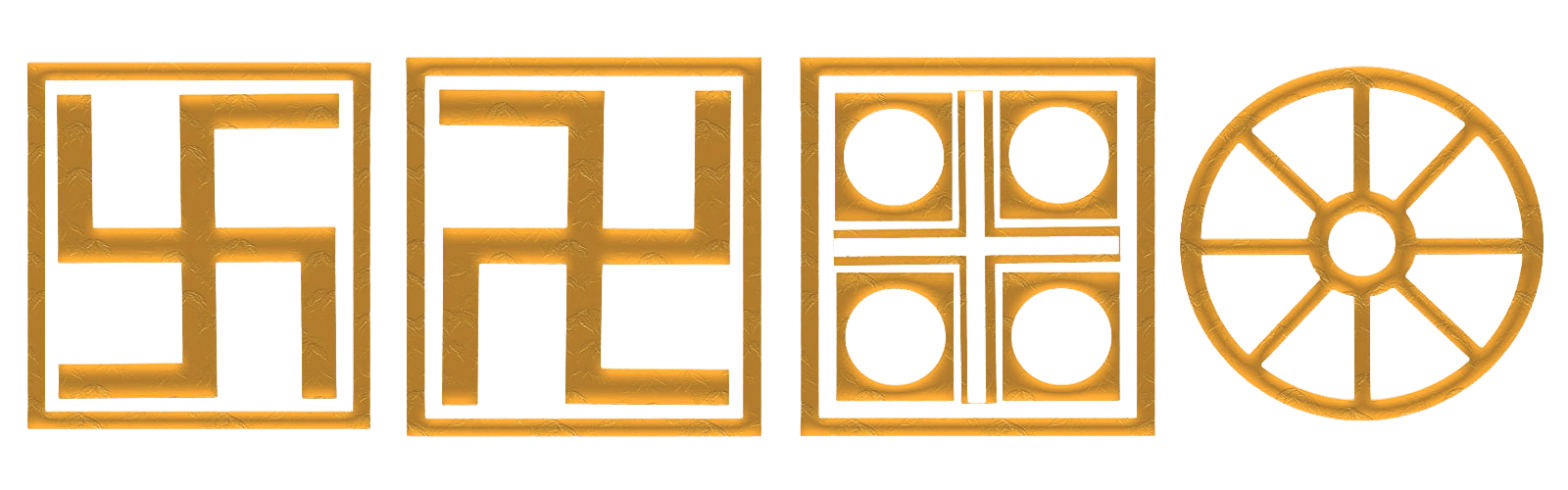
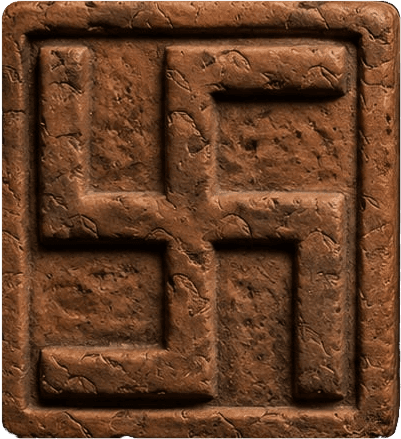
The swastika.
The swastika is the oldest symbol this tradition holds, and it belongs to it from before Siddha Dharma existed, as the mark of this current. It does not stand alone. Ko Boonak's swastika is paired with Po Boonak's reversed swastika, one orientation to each, which is why this tradition possessed the swastika in both directions, right and left, from the beginning.
The mark is also why this current was renamed as it was. When the Siddhas of Siddha Dharma gave the four old currents Sanskrit names, Ko Boonak became Swasti Dharma, and Kalyana Dharma in Hindi. Both words carry the swastika's own sense of well-being.
Section 05
The gods and goddesses of Ko Boonak
Reserved for a future entry from the tradition's record.
Section 06
Ko Boonak in a modern frame
Most people arrive at a religion expecting an answer to be handed over. Ko Boonak hands over a question instead, and treats the asking as the point.
A serious scholar will rightly say: a tradition still asking who made the world, generation after generation, is a tradition that never worked it out. Questions are what you have before you have knowledge, and a religion that never closes them sounds like a religion that never arrived anywhere.
The people of Ko Boonak would not have recognised that as a criticism, and the reason matters. They were not holding the question open because no answer had come; the answer came in every generation, through a living guru who could be entered by the deity and asked, and so what stayed open was the channel. Perhaps that is confidence of an unfamiliar kind, for it lay in the matter being raised and met, never in already possessing the answer, and that indeed is a different thing from doubt.
Two further things sit inside this current.
The first is the refusal to choose. God with form, God without form, and God incarnate became, across much of later religious history, three positions that people separated into schools over and sometimes fought about. The people of Ko Boonak are recorded as believing all three at once, and so this community never had to decide between the God you can picture and the God you cannot, and never had to lose either.
The second is in the list of questions itself. Who made the clouds, and will the fields come good. Who made sorrow, and take this trouble away. The cattle are in the prayer. There is no sacred register here and no separate mundane one, and anyone taught that spiritual life means turning away from ordinary concerns will find that Ko Boonak does not recognise the distinction at all. It brought everything to the same place and asked about all of it in one breath.