
In Siddha Dharma, knowledge of Ritavyu begins with Ishanak's declaration:
“I am Ritavyu.” — Ishanak
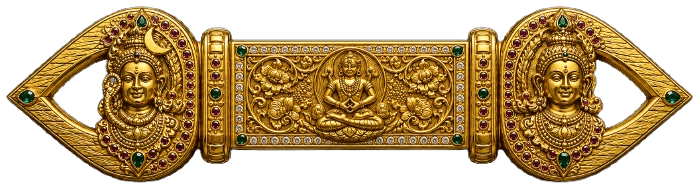
Through this name, Ishanak reveals the power that sets the elements of the universe into motion and sustains their activity. Ritavyu's form brings together Jaon Devta, KheDataru Devta, TangaD, MangaD and the golden body from which beings emerge and into which they return.
Section 01
Rit and the Wheel of Creation
Rit is the power that keeps the universe in order. It is distinguished here from Ritavyu, the deity through whom that power operates. Its movement is apparent in the seasons, though the seasons of flowering and fruiting on earth are only part of it. Stars and worlds have their own cycles of birth and death. Time also moves within this order.
Water flows from the mountains towards the sea. Wind blows, clouds gather and rain falls. The power that gives the original impulse to the elements and their activity is Ritavyu. Prerna, the impulse that sets them in motion, belongs to his function.
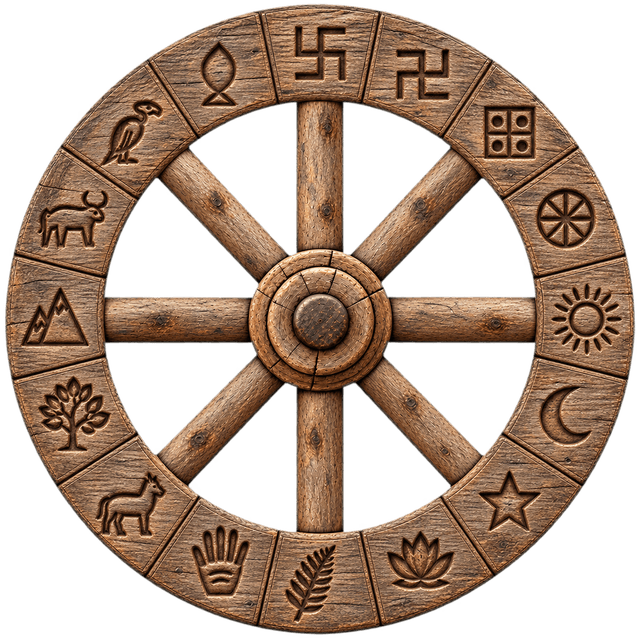
Ritavyu's vyuh Shakti is explained through a chakra, a wheel: through its turning, cosmic order continues, the elements remain active, beings are born and die, and creation moves through its cycles. This is the power expressed in Ishanak's declaration.
Section 02
The Body of Ritavyu
The body of Ritavyu is formed through the conjunction of divine powers. Ishanak is his head. Jaon Devta is his right hand, KheDataru Devta his left, and TangaD and MangaD are his two feet. These powers together constitute Ritavyu; he has no separate, individual form apart from their union.
His chest, abdomen and back are described as a golden sphere, compared with Hiranyagarbha, the golden womb of creation, from which emerge divine powers, beings and the many forms of existence, and into which they return. This movement continues through successive creations.
Even the great rishis are said to have seen only a portion of this golden immensity. What is visible is like the small part of a globe that one can see at a time, from which its greater extent is understood. The whole has not been perceived.
Jaon creates anew, and each creation need not repeat the one before it. Because human beings, Devas and Daityas exist in the present creation, it does not follow that the next must contain these same forms. The arrangements can change. Ritavyu governs the order within which their emergence, death and return take place.
TangaD and MangaD are themselves sources of many other deities. MangaD also has a place in the origin of mantra, spoken of as mana.
Mahasiddha Ishaputra has suggested that MangaD may be a form of Jaon, or related to KheDataru, because their functions resemble one another. This relationship remains a suggestion of Mahasiddha Ishaputra. Ishanak has not declared that identification.
Knowledge of these divine forms requires a particular state of consciousness. Soma is recalled in connection with that state and with earlier practice, although the identification of Soma remains disputed.
Section 03
Jaon Devta: Life and Consciousness
Jaon Devta, the right hand of Ritavyu, is connected with the function known through Yamaraj. His concern extends beyond the death and judgment of human beings. It includes the life present throughout the universe.
One vast atma pervades everything: mountains, water, trees, animals and human beings, equally in darkness and in light; the atma is one, while its appearance differs according to the being or substance through which it becomes manifest.
Khilna means to flower. As a flower opens, so the atma flowers differently in different beings. Prāṇa gives the opportunity for consciousness to arise, and chetana, the capacity for awareness, thought and understanding, develops to different degrees.
An ant and an elephant are both alive. Their capacities differ. The elephant has greater powers of perception and action, and the consequences of its actions are considered accordingly. Responsibility follows the consciousness through which an action is performed.
If the atma is one, and that atma is a kalā of the deity, who receives punishment? The distinction lies between the life principle and the consciousness that develops through it, for prāṇa provides the opportunity to become conscious, while the consciousness that acts receives the consequences. Greater consciousness brings greater responsibility, as well as a greater capacity to know the universe.
Prāṇa is present even where it remains inactive. In a stone, consciousness has not flowered into the perceptible activity of a living creature, yet the life principle is still present. Its presence and its active expression are distinct.
Consciousness can grow through sādhana, tapas, yantra, mantra and the methods of practice. A being's present condition does not fix the extent to which its consciousness can develop.
Section 04
KheDataru Devta: The Record of Every Action
KheDataru Devta is the left hand of Ritavyu, whose name is explained through the Pahari expression for drawing or making: whatever a being does, KheDataru draws it, preserving the image of the action.
Thousands, lakhs or crores of images are said to be made within the blink of an eye. These numbers express an immeasurable capacity. They convey how much can be recorded in the brief interval between closing the eyes and opening them again.
Thoughts are recorded too. What takes place in the mind and chitta is drawn along with the body's outward actions, its breathing, its eating and the activity within it. The record reaches through the many processes that constitute a life.
As an exploded view of the human body can show skin, flesh, fat, bones, the beating heart and the filtering kidneys distinctly, although they belong to one body, so KheDataru draws what takes place within a being as well as what it does outwardly. Taking fruit from another person's field also has its image. Denying the act cannot erase it.
The comparison with Chitragupta concerns this recording and showing of deeds. Yamaraj can be questioned, as in the example of Nachiketa, while KheDataru brings the being before the record of its own actions. He shows what was done without entering into an argument.
Imagine a river that has frozen. One can move along its length, forwards or backwards, examining what is preserved within it, just as the actions of a life remain available to be seen when KheDataru points them out with his staff. Consciousness is shown its own deed before the consequence is given.
The record survives the dissolution of a universe. Jaon's form can change with a new creation, while KheDataru remains the same and the images he holds endure. Ishanak keeps the account of the universe through this form, even when a creation has ended and another begins.
Section 05
Jampri and the Responsibility of Living Beings
Jampri is distinguished from Yampuri. Yampuri is a particular place; Jampri is a gate through which a being is sent according to its condition. The older expression Jampri is also related, in this teaching, to the later name Yampuri. Jaon and his associate determine where the being is to go, and there are many such gates.
Animals also receive consequences appropriate to their consciousness, so a dog that has lived faithfully beside a human being has its own life, understanding and capacity, according to which its condition after death is considered. The same principle applies to other animals.
This understanding enters the way we care for living beings. Animals that have died are given proper final care. Before cutting a large tree, forgiveness is sought from the tree and from the deities, including Jaon and KheDataru, who holds the record of the act.
The universe provides what living beings need, and they must use it according to their consciousness. Drinking water and eating suitable food are ordinary, permitted acts. The permission has limits: the degree to which consciousness has flowered matters to the consequences of mistreating a being.
The comparison extends to Devas and Daityas. Consciousness is described as more fully flowered in the Devas, and harm has different consequences according to the consciousness involved. Capacity, action and responsibility are considered together.
An animal undergoing consequences after death is also distinguished from an animal that forms part of an environment of punishment. A blade-leaved tree or a creature encountered in such a place does not, by its presence alone, establish that the tree or creature is itself being punished.
Section 06
The Iconography of Ritavyu Devta
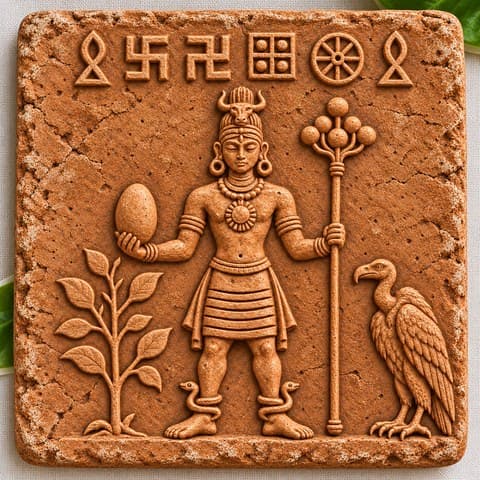
Ritavyu's image expresses the powers brought together in his form. His right hand holds Sune Ra Dalo, the golden egg symbolizing Brahmand, the universe. It expresses Hiranyagarbha, the golden womb of creation. His left holds a staff bearing six round balls, one at the top and five attached beneath it in a canopy-shaped arrangement, signifying authority, law and cosmic order.
A large solar orb hangs at his neck as an ornament representing Mahasurya; above the forehead, on the crown, Ishanak is signified by a bull emblem, shown either as a bull's head or as a small complete bull.
Five lines on the garment signify the five elements. Serpents encircle the ankles, expressing the powers of Kala associated with time, destruction and dissolution.
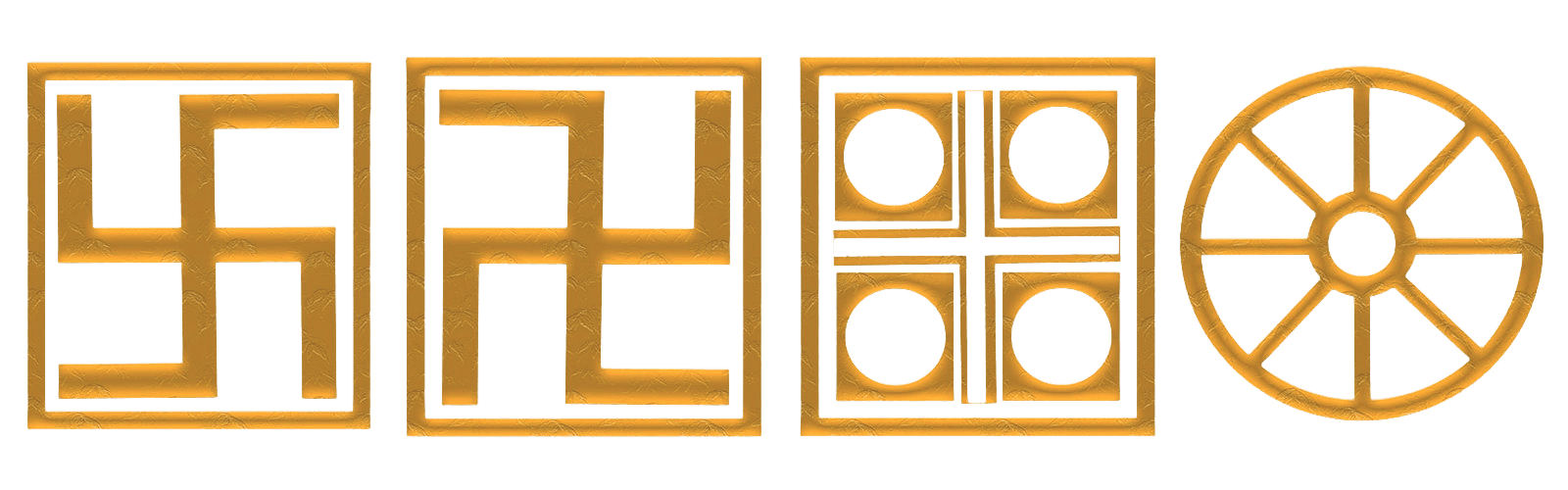
A vulture stands on his left, with a plant on the opposite side. Above the figure, a band of Kopo Khoja motifs is flanked by fish signs.
The relationships between these powers belong to the meaning of the image. Bahuswaroopvad names one deity appearing through many forms. Ishanak, Jaon, KheDataru, TangaD and MangaD are brought together in the body of Ritavyu, each with a function that can be understood in its own right. Their conjunction presents the order through which creation continues and the lives within it unfold.
These teachings are drawn from the Siddha Dharma tradition of Kaulantak Peeth, as explained by Kaulantak Nath Mahasiddha Ishaputra.