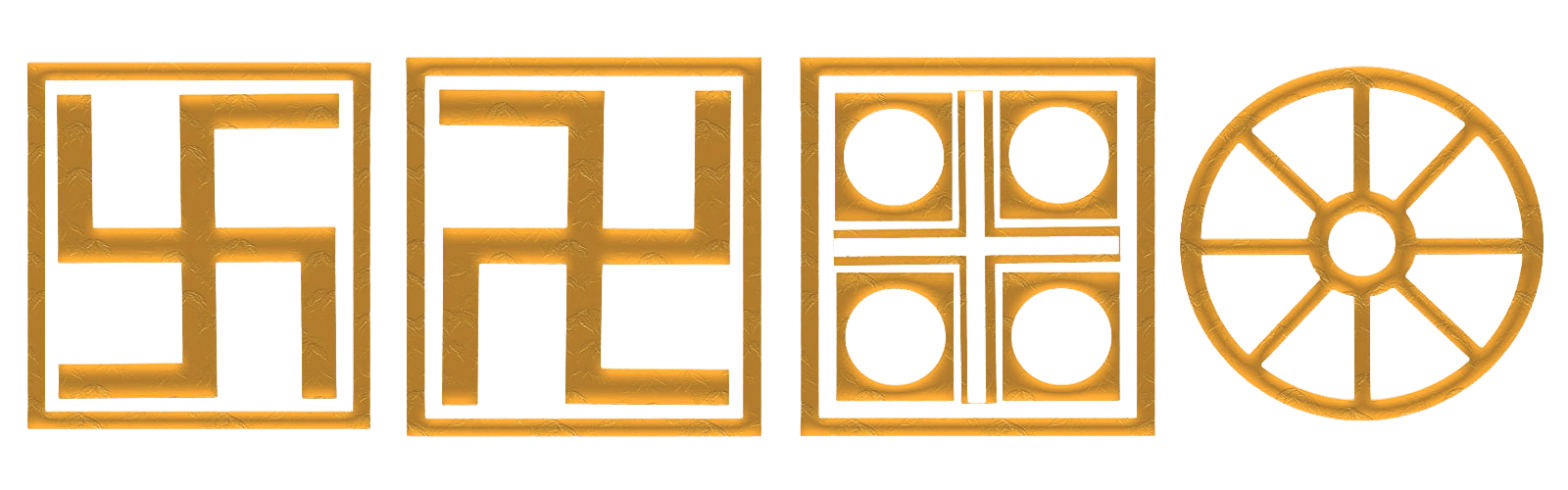
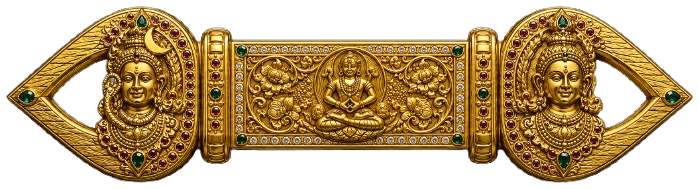
This ancient mark is called Aathbato Deu. Aath is eight, and bāṭo is road: the eight roads. It is the mark from which Boon Kala, the ten Boon Kala paths of Siddha Dharma, were born, and with it comes the story of how the worship and sadhana of Ishanak Deu began. One could call it the very first beginning of tantra.
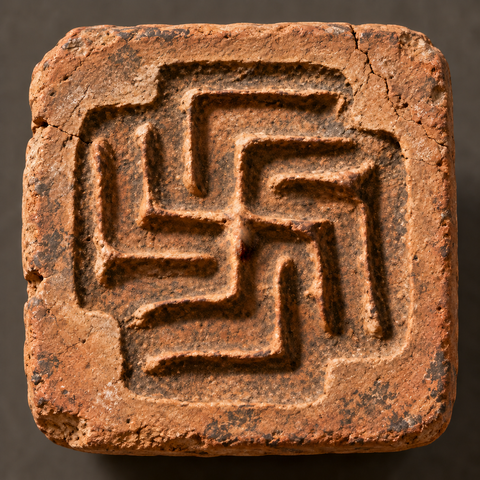
The mark
A small square tile of fired clay, its corners worn round and a crack running down from the upper edge. Pressed into its face is a sunken field whose outline steps in at two opposite corners, so that the border itself seems to turn. Inside it stand raised ridges in two rings. The inner ring is a svastika: four arms meet at the centre and each turns at its end in the same direction. Around it, set apart from the centre and not joined to it, a second ring of four bent ridges follows the same turn. Four arms within and four without make eight ridges in all, and between them the channels wind inward like the paths of a maze toward the single point at the middle.
The story of the eight roads
Some of the Pura Gana, the ancient gana, went in search of Ishanak Deu. They were eight in number, and they walked calling out to him. On the way the eight met a companion, the one called Gheru.
Gheru told them that the Deu they were looking for does not live on the earth, nor in the sky, nor in water: he is the Deu who dwells in all. They could search forest after forest, mountain and plain, sea and river and tree, and it would come to nothing. Gheru said that he knew where Ishanak Deu was to be found. But he could not decide alone by which road to go to him, because Ishanak Deu was hidden in the Aathbato.
All of them asked what this Aathbato was. So Gheru took them up onto a high mound, and from there they saw in the plain below a labyrinth. That labyrinth is what is called the Aathbato.
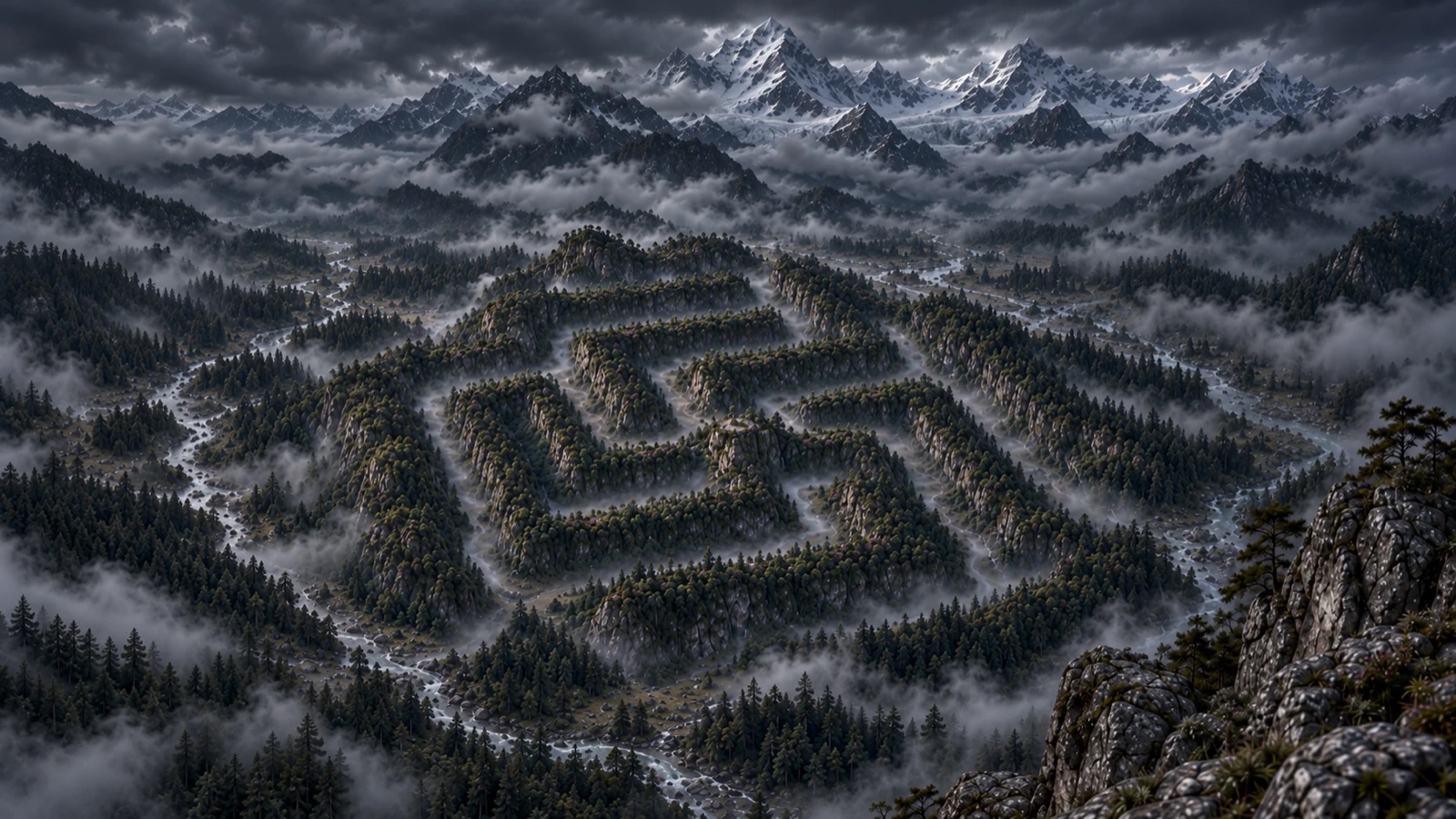
This figure, the one on the mark, had been seen first of all by Gheru. He had seen a fierce whirlwind coming across the plain, so vast that its size could not even be guessed. When that great storm of dust, a storm like the end of the world, came to rest, he saw Ishanak Deu standing in the middle of the Aathbato the storm had made, so immense that he reached up to the sky. Along those eight roads, each by a road of its own, things were coming toward Ishanak Deu: fierce fire, water, wind laden with earth, the colours of the rainbow, a black darkness full of sound, a substance full of bewilderment, and something unknown that was there and yet could not be known.
After a time all of it grew calm, and Ishanak Deu too grew smaller and smaller, until he was like us, and somewhere on top of this Aathbato he has sat down.
Gheru wanted to go there. But by which of the eight roads?
Then they all said: we are nine. Let one stay here on the high mound and guide the eight who go down, so that no one is led astray, and we will reach Ishanak Deu.
So Rato, one of the Pura Gana, stayed on the mound, and the other eight, Gheru among them, went into the Aathbato by the eight roads. It took them sixteen days inside to reach the summit, and only then did they find Ishanak Deu. For sixteen days they stayed with him, and there, on top of the Aathbato, they received knowledge from Ishanak Deu. Each of them had climbed up from his own side, and each sat right there, where he had come up.
Darshan of Ishanak Deu
Then they saw a wonder. It was as though the head of Ishanak Deu were in every direction: in each of the four directions, with one face, he was giving knowledge to two of the Pura Gana, face to face. That is why, of his four faces, three are seen by any one who looks upon him.
Two of the Pura Gana heard only the sound and could not see the face of Ishanak Deu, because from far off it looked to them as though his face were spinning fast, round and round like the wheel of a chariot. Because his head turned like a chakra, they could not see his face clearly, and so theirs became the guhya, the secret, tradition.
Most of the time Ishanak Deu had only two hands. But when he moved his hands, such a wonder took place: the hand that was down was still there below, and as he raised it while teaching, new hands seemed to come out of those very hands until there were many, and in the end they merged back into those same hands.
When he spoke he took no breath, and he did not stop. Sound came from his mouth without a break. His face seemed like the face of a great being who had come right up to yours to speak, very close, though he was far away. Looking at him, it seemed that his mouth was closed and he was smiling, and then suddenly he was seen to be speaking; looking again, intently, his mouth was once more closed and smiling, and yet his voice went on.
He was never seen to turn his neck. Suddenly his face would dissolve and appear in another direction.
Never before and never after did they see anything like it.
As tiny motes can be seen in a single ray of light, so the body of Ishanak Deu was full of such motes. Sitting near him, the mind and every thought came to a stop. A light that filled them with bliss, and the felt sense of being free and unbound, grew strong, and it became lasting.
And it is said that simply by sitting near these Pura Gana, people too would become divine.
The ten roads
It is said that in that same time another of the Pura Gana, Keelu, also went into the Aathbato, but could not climb up. Keelu stayed below, in the foothills.
Later it became known that what Ishanak Deu had said and taught was heard by ten of the Pura Gana. Then these ten began, each one, to share what they had received, and the Dasbato, the ten roads, was founded. Yet the recognition went to the Aathbato alone, and to its Deu, Aathbato Deu. This mark is his mark.
The ten Pura Gana
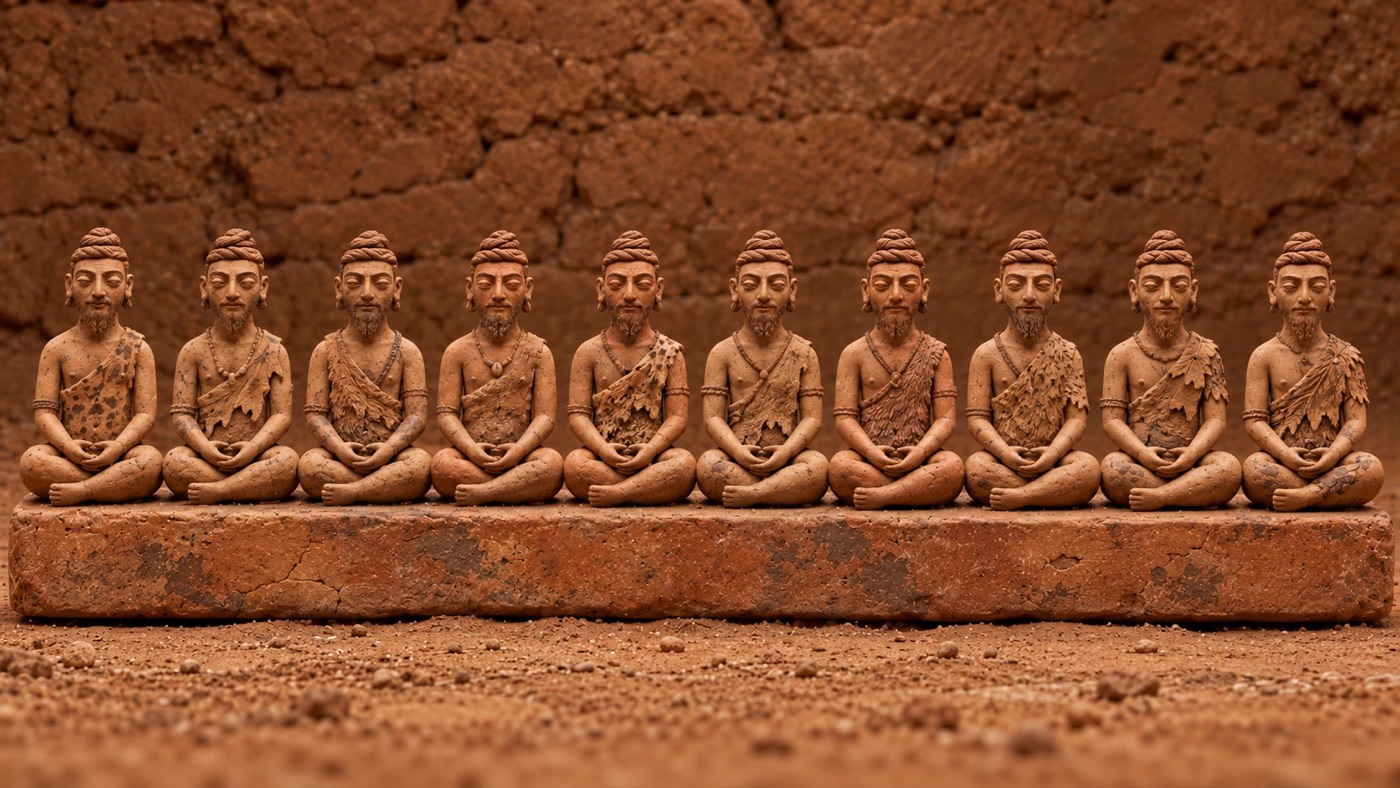
Here the ten sit together in a single row on one long bench of fired clay, weathered and stained, set on bare earth before a wall of rough clay blocks. Each sits with legs crossed and hands cupped together in the lap, back straight, eyes closed. Their hair is gathered high into a coiled knot, their ears are long, and each has a short beard and a moustache marked in fine lines. Each wears a necklace of beads with a small pendant, bands on the upper arms and wrists, and a single garment thrown over one shoulder and across the chest: on some a spotted hide, on some a shaggy fur, on others what looks like layered leaves. No one of them is set apart from the others by size or adornment.
The ten Pura Gana are Mahasiddhas: the first to make the method of sadhana. They are not among the twenty-one Ganak. In Boon Kala their roads are the ten roads to the siddhi of Ishanak Deu, and eight of them are the principal roads.
Each of the ten is given here by the name spoken in the local tongue, with the tantric name by which he is known as a Mahasiddha.
- Gheruमहासिद्ध त्रिघेरी नाथMahāsiddha Trigherī Nāth
- Keeluमहासिद्ध कीलक नाथMahāsiddha Kīlak Nāth
- Ahiruमहासिद्ध अहिरवर्ण नाथMahāsiddha Ahiravarṇ Nāth
- Daitiमहासिद्ध व्याघ्रघाती नाथMahāsiddha Vyāghraghātī Nāth
- Chhunuमहासिद्ध छिन्नवक्ष नाथMahāsiddha Chinnavakṣ Nāth
- Masnuमहासिद्ध मासन नाथMahāsiddha Māsan Nāth
- Chhapaमहासिद्ध छत्रभेद नाथMahāsiddha Chatrabhed Nāth
- Keepaमहासिद्ध कीपकर्ण नाथMahāsiddha Kīpakarṇ Nāth
- Hungshaमहासिद्ध हुंगकारी नाथMahāsiddha Huṃgakārī Nāth
- Ratoमहासिद्ध सोमरात्रि नाथMahāsiddha Somarātri Nāth
The roads of Rato and Hungsha stand a little apart from the others. From that time on their roads have been called guhya, secret.
These ten roads are what, in time, became the Āmnāyas.
After the ten roads
Of the eight who had climbed to Ishanak Deu, four separated from the others. Of the Aathbato they said that this image and this rite were not right, and then the Aathbato came forth reversed, as Po.
The ten did not proclaim Kopokhojaa. Theirs was only the beginning, and the time for that proclamation came later. It was those who learned after them who, in time, established Ko, Po, Kho and Jaa: from the line of the first four came Ko Boonak, from the four who separated Po Boonak, from Keelu, who had stayed below in the foothills, Kho Boonak, and from Rato, who had stayed on top of the mound, Jaa Boonak. Rato's own road is guhya, secret, and yet Jaa Boonak, which grew from it, is the one that became the more widely known.
After this, Boonak was established. Boona Kala is the Dharma of Nature: Boon stands for the natural world, its rivers, mountains and forests, and Kala for the spiritual arts by which that world is understood and by which a person is liberated within it. In time Boona Kala took a structured form in four traditions, Ko, Po, Kho and Jaa Boonak, known together as Kopokhojaa.