
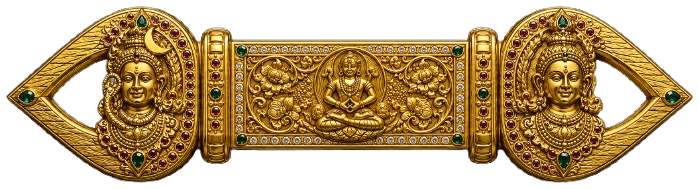
Vishvaloki Dharma (विश्वलोकी धर्म, Viśvalokī Dharma) is the fifth of the five dharmas of Siddha Dharma.
Viśva is the all. Loka is the world, and lokin is one whose seeing takes that in, so the viśvalokī is the one who looks at the whole of things at once, the near and the far, the welcome and the unwelcome, and does not look away from any of it. The dharma is the way of living from that look.
Section 01
What this dharma is
Vishvaloki Dharma is the universal view of divinity. Its teaching, as Siddha Dharma states it, is that the entire universe is Ishwar and that all experiences are divine. Its practice is detachment from transient experiences, in the recognition that joy and sorrow are shaped by time, place and circumstance, and that what is shaped by circumstance is not the thing to build one's life on.
This is the path that transcends the pairs. Pleasant and unpleasant, gain and loss, the good harvest and the failed one, the festival year and the year of mourning, the year a child is born and the year a parent dies: the follower of Vishvaloki Dharma takes all of it as one field, and the field is Ishwar. Nothing is outside. So nothing in experience has to be fled from, and nothing has to be clung to.
Section 02
Its place among the five
Set beside the others: Deva Dharma meets Ishwar in one form, Vishuddhi Dharma meets Ishwar beyond form, and Vishvaloki Dharma finds that there was never anywhere Ishwar was not. The five are not steps on one ladder, and nobody is asked to pass through the first four to reach this one. It is a complete road for the person whose temperament it fits, and it is held, like the other four, under Sthiti Dharma, the settled view of Kaulantak Peeth that no path is incomplete and no path invalid.
Section 03
What its people hold
- The universe is Ishwar. Entire, with nothing left over.
- Joy and sorrow are conditions of time, place and circumstance, and they pass because their conditions pass, the way weather passes over a valley that stays where it is.
- Detachment is not coldness. It is the refusal to make a passing condition into a permanent judgement about life.
- Every experience is a meeting with the divine. The welcome ones and the other kind.
Section 04
Its granthas and Siddhas
Reserved for a future entry from the tradition's record.
Section 05
Its practices
Reserved for a future entry from the tradition's record.
Section 06
Vishvaloki Dharma in a modern frame
The objection to this dharma is old and it is serious: “everything is God” can be the position a tradition takes when it has stopped being able to say anything in particular, and a teaching of detachment from joy and sorrow can be used to tell people in real sorrow that it does not matter.
The people of this dharma would answer with the company it keeps. It is listed with Deva Dharma, where the village deity is real and is served, and with Pratigyaan Dharma, where a single vow is kept for a lifetime. The universal view in Siddha Dharma sits beside the particular, in the same list, under the same roof, and so nobody here says the deity does not matter or the sorrow is not real. What Vishvaloki Dharma says is narrower and harder: that the sorrow, too, is a meeting with Ishwar, and that it will pass because the time and place and circumstance that shaped it will pass.